
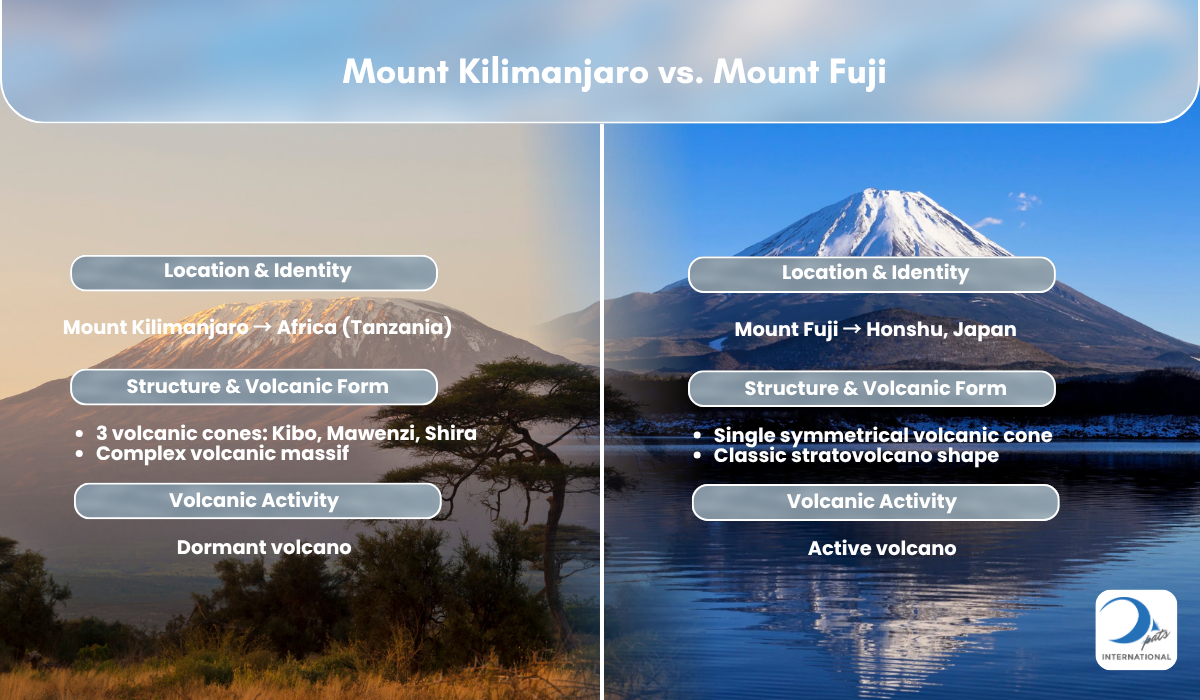
Mount Kilimanjaro has a height of 5,895 meters, and Mount Fuji has a height of 3,776 meters. Mount Fuji is easier to scale than Kilimanjaro. Kilimanjaro takes much longer to climb. Mount Fuji is a high-elevation summit hike with a moderate altitude challenge. If you want a fast climb, Fuji is better. Kilimanjaro is a slow climb due to its height and difficulty.


- What is the difference between Mount Kilimanjaro and Mount Fuji?
- Where are Mount Kilimanjaro and Mount Fuji located?
- Is Mount Kilimanjaro higher than Mount Fuji?
- Mount Kilimanjaro vs Mount Fuji: which is more challenging?
- Which requires better fitness: Mount Kilimanjaro or Mount Fuji?
- How long does it take to climb Mount Kilimanjaro vs Mount Fuji?
- How much does a Mount Kilimanjaro climb cost compared to Mount Fuji?
- Mount Kilimanjaro vs Mount Fuji: which has better views?
What is the difference between Mount Kilimanjaro and Mount Fuji?
The difference between Mount Kilimanjaro and Mount Fuji is given in the table below.
| Feature | Kilimanjaro | Fuji |
| Location | Africa | Honshu |
| Peaks | Three | One |
| Elevation | 5.9 km (3.7 miles) | 3.8 km (2.36 miles) |
| Trek time | 1-2 weeks | 1-2 days |
| Hikers | 50,000 per year | 300,000 per season |
| Status | Dormant | Active |
| Form | Plate collision | Plate boundary |
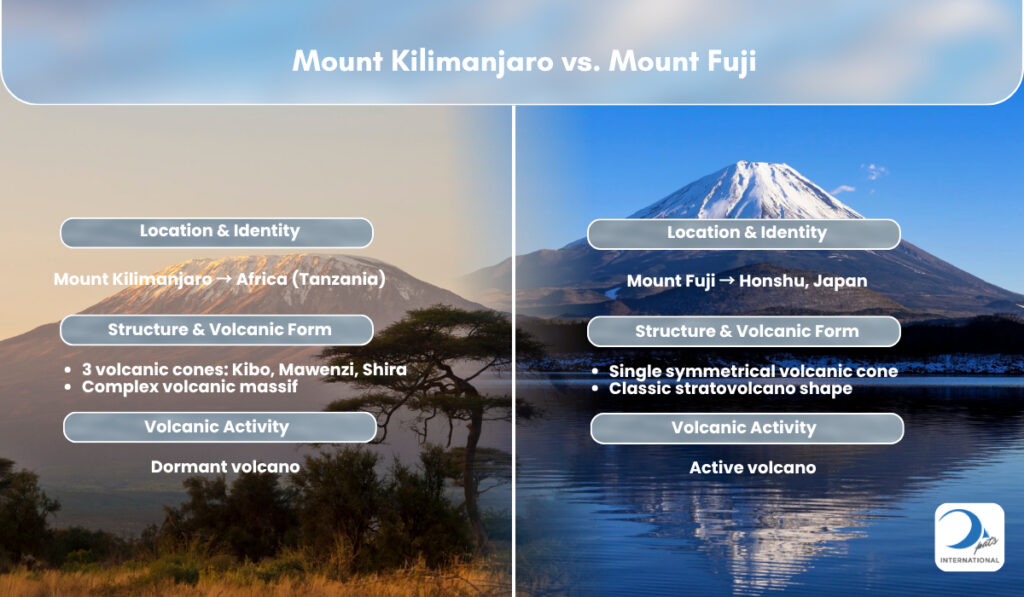
Mount Kilimanjaro is in Africa, and Mount Fuji is in Honshu. Mount Kilimanjaro has three volcanic peaks: Kibo, Mawenzi, and Shira while Mount Fuji has a single cone. Mount Kilimanjaro has an elevation of nearly 5.9 kilometers (3.7 miles), and Mount Fuji has an elevation of about 3.8 kilometers (2.4 miles). Mount Kilimanjaro is dormant while Mount Fuji is active. Mount Kilimanjaro formed through volcanic activity from a tectonic plate collision whereas Mount Fuji formed through volcanic activity at a tectonic plate boundary. Mount Fuji last erupted in 1707.
Mount Kilimanjaro’s trek takes approximately one to two weeks while Mount Fuji’s trek takes 1 to 2 days. Mount Fuji has 300,000 hikers per season, and Mount Kilimanjaro has 50,000 hikers per year. Mount Kilimanjaro is a nontechnical climb whileMount Fuji has steep terrain.
Mount Kilimanjaro has glaciers which have shrunk. Mount Fuji has a layer of ice and the glaciers are stable. Mount Kilimanjaro is a protected natural landmark while Mount Fuji is a UNESCO-listed landmark.
Where are Mount Kilimanjaro and Mount Fuji located?
Mount Kilimanjaro is located on the African continent, and Mount Fuji is on the Asian continent. Mount Fuji is in central Honshu, 100 kilometers (62 miles) from Tokyo.
Is Mount Kilimanjaro higher than Mount Fuji?
Yes, Mount Kilimanjaro is higher than Mount Fuji. Mount Kilimanjaro has an elevation of 19,341 feet (5,895 meters) above the ocean’s surface. Mount Fuji has a height of about 2.3 miles (3.7 kilometers). The difference in height is just over 1.6 kilometers, or about 1.3 miles.
Mount Kilimanjaro vs Mount Fuji: which is more challenging?
Mount Kilimanjaro is more challenging than Mount Fuji. Kilimanjaro is nearly 5,895 meters high, and Fuji is 3,776 meters tall. The height difference leads to the difference in time needed. Kilimanjaro requires roughly a week for ascent and descent, but Fuji takes a day or two.
Acclimatization separates the two mountains. The factor of altitude makes Kilimanjaro more dangerous. There is a higher chance of mountain illness on Kilimanjaro because of extreme elevation. Kilimanjaro has 10 deaths annually, and Fuji has 5 to 10 deaths annually.
Both are nontechnical hikes, and beginners can try both. Slope contrasts show steeper sections near the summit on Fuji. The Yoshida trail’s final push on Fuji has steeper sections while Kilimanjaro has gradual slopes. Kilimanjaro requires licensed guides and porters because of Tanzanian law. Summit success patterns show 45 to 65 out of every 100 climbers reach the top on Kilimanjaro. Fuji has nine out of ten or more reaching the top.
Logistics cover international travel and entry costs for Kilimanjaro, and Fuji has domestic accessibility. Both have narrow short climbing seasons and cold temperatures. Kilimanjaro is about 20°Celsius, and Fuji reaches 50°F (10°C). Fuji attracts more casual hikers. Kilimanjaro shows unique landscapes through five ecological zones, and Fuji through volcanic terrain. Kilimanjaro has the Rebmann icefield, and Fuji has a symmetrical cone.
Which requires better fitness: Mount Kilimanjaro or Mount Fuji?
Mount Kilimanjaro needs better fitness than Mount Fuji. Mount Kilimanjaro has a climbing duration of around a week while Mount Fuji needs one to two days. Mount Kilimanjaro has extreme altitude, and that leads to severe lack of oxygen. The body fights against thin air, and getting sick from high altitude affects the chance of reaching the top. Mount Kilimanjaro’s top is in the arctic zone, and has freezing temperatures and oxygen levels near 50% of ground level. Mount Fuji’s top is below extreme height limits, and does not have long-lasting thin-air strain. Mount Kilimanjaro requires carrying backpacks of 10 to 15% body weight across multiple days, and needs endurance for daily climbing up to a half to one kilometer. The total physical toll builds over many days, and fatigue comes from cumulative exertion, trouble sleeping at altitude, and appetite loss. Mount Fuji’s fatigue is muscular tiredness from steep climbing. Mount Kilimanjaro’s fitness needs moderate to high conditioning and ability to sustain physical activity for consecutive days.
Mount Kilimanjaro’s training lasts a few months to half a year and has 3 to 4 weekly sessions. Training mixes strength, weighted steep incline, and cardio workouts. Mount Kilimanjaro needs building fitness to climb 3,280.84 feet (1,000 meters) up and descend with weight on consecutive days at moderate heart rates. Mount Fuji’s preparation uses cardio sessions 3 to 4 times weekly, and each session has a duration of half an hour to an hour. Mount Fuji’s preparation uses weightlifting, and physical readiness focuses on hill walking with heavy backpacks. The training works legs, hips, core muscles, and the back. Stamina is the primary factor for Mount Fuji. Mount Kilimanjaro tests mental resilience, and prolonged exposure to extreme elevation causes strain. Guides cannot make up for insufficient acclimatization or endurance. So, Mount Kilimanjaro needs better fitness.
How long does it take to climb Mount Kilimanjaro vs Mount Fuji?
It takes 6-9 days to climb Mount Kilimanjaro while it takes 1-2 days to climb Mount Fuji. Mount Kilimanjaro has a high-altitude experience and needs acclimatization for reaching the top. So, it has a slow pace for acclimatization. Mount Fuji does not have this need because of its lower elevation. However, Mount Fuji has a steep climb rate per day, which is why it is fast. Mount Kilimanjaro requires a mandatory guide whereas the guide for Mount Fuji is optional.
Mount Kilimanjaro has a summit day length of 10 to 14 hours. That is the climb from high camp to the top. Mount Fuji has a climb duration from the fifth station of nearly two days. That is the climb to the top and climbing down. Mount Kilimanjaro’s climb down takes 1 to 2 days. Mount Fuji has a climb down period of a full day. Mount Kilimanjaro’s summit day is very slow because of altitude, and Mount Fuji’s summit day is fast.
How much does a Mount Kilimanjaro climb cost compared to Mount Fuji?
The cost to climb Mount Kilimanjaro goes from $3000-$6000. The cost to climb Mount Fuji goes from $100-$600.
Duration causes variation in expense. A Mount Kilimanjaro climb takes 5 to 9 days, and a Mount Fuji climb needs 1 to 2 days. Because of this, Mount Kilimanjaro has a higher rate per day. Travel arrangements cause variation as well. Mount Kilimanjaro requires international flights to Tanzania, but Mount Fuji is accessible from Tokyo by public transit. Mandatory services cause variation in expense. Mount Kilimanjaro requires tour guides and porters, while Mount Fuji has optional guides. The Mount Kilimanjaro budget covers emergency charges, equipment, food, and employee pay.
Mount Kilimanjaro vs Mount Fuji: which has better views?
Both mountains offer differing views. Mount Kilimanjaro has views across Tanzania and Kenya. It has grassy flatlands, glaciers, a rainforest, and a high mountain barren area. Mount Fuji has a symmetrical cone and a crater diameter of about 0.5 miles (0.8 kilometers). Views on Mount Kilimanjaro range from rainforest to glaciers. Watching the sunrise on Mount Fuji needs a predawn departure. On Mount Kilimanjaro, the predawn climb is slow because of the high mountain barren area. On Mount Fuji, the predawn climb is fast because of the symmetrical cone.


