At 5,895 meters, the summit of Kilimanjaro has around 50% less oxygen than at sea level. Every time you breathe, you take in about half as much oxygen. The proportion of oxygen is unchanged whether at sea level or Kilimanjaro. However, because of reduced oxygen pressure at higher elevation, oxygen intake is lower. Acclimatization is how the body gradually adjusts to reduced oxygen pressure as you climb higher. Due to acclimatization, trekkers do not require extra oxygen to climb Kilimanjaro.


Do you need oxygen to climb Mount Kilimanjaro?
Most people do not need supplemental oxygen to climb Mount Kilimanjaro. The typical approach is to climb without an oxygen tank as the body adjusts through acclimatization. Operators focus on gradual pacing which helps climbers get acclimated. Kilimanjaro has a height of 19,341 ft (5,895 m). Atmospheric pressure is 40% of the ocean’s surface. Climbing is demanding because of high elevation.
The majority of the climbers reach the summit without supplemental oxygen. However, altitude sickness is a risk. Supplemental oxygen is backup. A small fraction of people who climb use supplemental oxygen.
How common is altitude sickness on Mount Kilimanjaro?
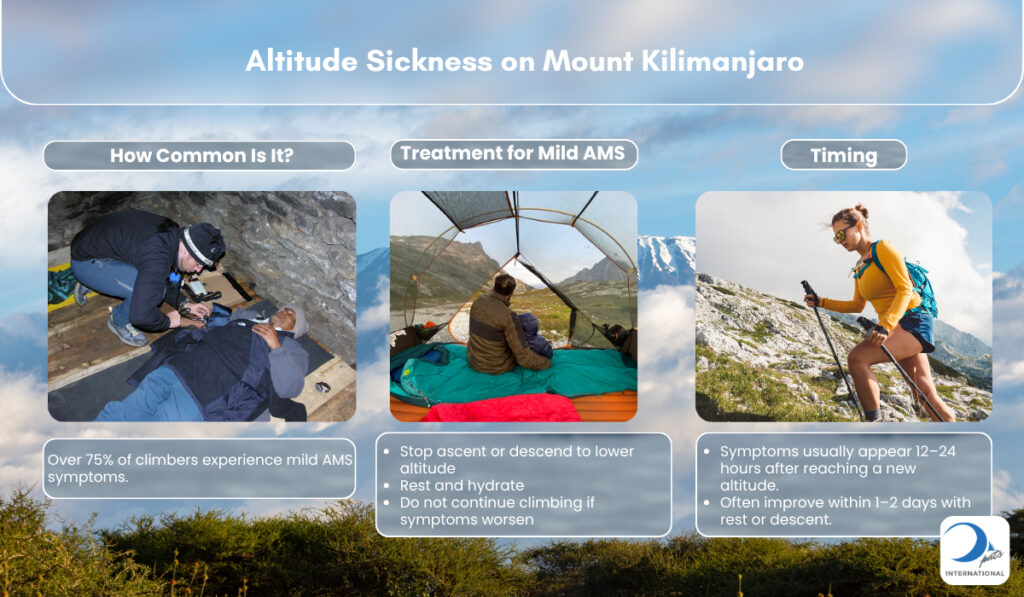
More than 75% of climbers suffer from altitude sickness on Mount Kilimanjaro. The high rate is due to rapid ascent. Mount Kilimanjaro goes to about 19,400 feet (5,913 meters). At the summit, the amount of oxygen is 50%. Atmospheric pressure falls at high altitude. Symptoms are apparent at 2.5 kilometers (1.55 miles).
Mild symptoms include poor sleep, fatigue, nausea, headache, and dizziness. Symptoms show 12 to 24 hours after reaching new elevation. Symptoms end within two days. Treatment is descent to lower elevation. Serious altitude sickness happens in less than 5% of cases. HACE is brain swelling, and both HACE and HAPE need immediate descent.
The body does not adapt to climbing without acclimatization. Acclimatization makes more red blood corpuscles and changes breathing patterns. A gradual climb lowers the risk of altitude sickness. Rate of ascent, individual physiological response, and hydration are key factors. Fitness does not stop altitude sickness as even fit individuals can experience altitude sickness. Taking more time to climb improves odds of reaching the top: the chance of success is 50% on week-long trips and 85% on longer routes.
How do you avoid altitude sickness on Mount Kilimanjaro?
To avoid altitude sickness on Mount Kilimanjaro take a longer route. Longer routes have a duration of about a week to a week and a half and cut acute mountain sickness risk by 50% because extended itineraries allow acclimatization. Shorter routes, like a five-day period, do not allow acclimatization, which is why risk is higher. Optimal seasons are January through March and June through October as they provide stable weather. Preacclimatization helps some climbers; it uses prior exposure to elevations above about 3,048 meters (10,000 feet). Take Acetazolamide or Diamox to adjust better. Dose of 125 to 250 mg twice daily starts one to 2 days before ascent. Climbers need 3 to 6 months (1.8 to 3.7 months) of heart and lung workouts, weekly hikes of 5 to 10 miles (8 to 16 kilometers) with weighted pack, and muscle training. Physical condition does not stop altitude sickness because lack of oxygen affects all individuals.
During the climb, follow the ‘climb high, sleep low’ strategy. Overnight altitude does not go up more than 300 to 500 meters (984 to 1,640 feet) per night above about 10,000 feet (3,048 meters). This acclimates you to the decreasing amount of oxygen in the air. Rushing raises acute mountain sickness risk, so saving energy improves odds of reaching the top to 90 to 98% on longer routes. Drink about a gallon of water daily because dehydration exacerbates mountain sickness symptoms like nausea. Avoid alcohol and caffeine; alcohol leads to dehydration and messes with acclimatization, and caffeine causes dehydration. Eat light meals with 60% carbohydrates for steady energy, not heavy or greasy meals. Climbers take a day off from climbing every 3 to 4 days above 10,000 feet (3,048 meters).
Guides use pulse oximeters and health checks. Acute mountain sickness scale scores above 5 demand descent. Severe altitude sickness causes confusion, inability to walk straight, shortness of breath at rest, or coughing frothy sputum, and that is when immediate descent of 984 to 3,281 feet (300 to 1,000 meters) is needed. Rapid descent is treatment for all forms of mountain sickness. Tour companies have portable oxygen and emergency exit strategies. Helicopter emergency teams can reach remote camps within half an hour to an hour. Severe altitude-related sickness affects up to 75% of climbers on Kilimanjaro. However, 50,000 hikers try Kilimanjaro annually and between 4 and 10 fatalities happen annually, so the death rate from untreated severe altitude sickness is 0.03%.
How does acclimatization work on Mount Kilimanjaro?
Acclimatization is a physiological process. The human body adapts to the amount of oxygen in the air, and that amount drops at higher elevations. Mount Kilimanjaro’s elevation is almost 6 kilometers (3.73 miles), so the summit has oxygen that is just under half of the oxygen at sea level. The body makes red blood cells and raises how fast you breathe, which is why, during rest, the body does not have low oxygen. This process uses protocols that reduce risk. The method is “climb high, sleep low”: climbers go down to a lower elevation, and the repeat pattern energizes the body.
Protocols suggest a maximum climb height of about 0.4 km to 0.54 km per day above about 3,048 meters, and a rest break happens every 1,969 to 2,953 feet (600 to 900 meters). Climbers keep hydration at three to four liters daily, and avoid alcohol and sedatives. If climbing goes faster than adaptation ability, high-altitude illness occurs. Kilimanjaro causes acute high-altitude sickness, which affects 75% climbers above 2.17 miles (3.5 kilometers). Symptoms include nausea, fatigue, headache, and dizziness. The condition moves to high altitude pulmonary edema or worsens to high altitude cerebral edema. Edema is fatal without descent.
Climbers choose routes that are longer, because longer routes have a higher chance of reaching the top. The Marangu path takes about a week, but its chance of success is lower. The Lemosho path takes about a week to a week and a half, and the Northern Circuit trek takes around a week to ten days. These paths have a summit chance of roughly 9 out of 10, while shorter routes have a summit chance of half to two-thirds. Operators use portable oxygen and hyperbaric chambers, but these are not acclimatization tools. Medication like acetazolamide speeds up acclimatization, stimulates the body, and cuts fluid buildup.
Why is it harder to breathe on Mount Kilimanjaro?
It is harder to breathe on Mount Kilimanjaro because the summit of Kilimanjaro is at about 5.9 kilometers (3.7 miles) and pressure drops at the summit. Atmospheric pressure at the peak is 40% of pressure at sea level. Air pressure at sea level is 1,013 millibars. Lower pressure leads to fewer oxygen particles in the lungs. The body breathes faster at altitude but faster breathing does not fully offset the lack of oxygen. Fatigue starts earlier at altitude because the body works harder at extreme altitude. Acclimatization is vital for survival.


