The average success rate of climbing Mount Kilimanjaro is around 78%. Official Kilimanjaro National Park reports an average success rate of 65%. Summit success rates range from 42% to 98%, and longer routes have success rates reaching 80% to 98%. 8-day routes have a 98% success rate. The Northern Circuit Route has the third highest success rate at 92%. The Lemosho route has a success rate of 96-98%. The Machame Route’s success rate is 88-92%. The Marangu route’s success rate is 42-56%, and the Rongai Route’s success rate is 80%.
What Are Your Chances of Reaching the Summit of Kilimanjaro?
We've calculated your personalized summit success score, recommended route, and training plan. Enter your details below and we'll send it straight to your inbox.
Enter your details and we'll email your personalized summit success score, recommended route, and training plan.
🔒 No spam. Your details are kept private and never shared.
Check your inbox!
Find your personalized assessment plan.
What is the success rate of climbing Mount Kilimanjaro?
The success rate for climbing Mount Kilimanjaro changes based on the path and itinerary length. Kilimanjaro park data from the early 2000s shows a 65% success rate. Current estimates show a 70-80% average success rate across all routes. Summit success rates grow with more rest days which is why longer itineraries help outcomes. Being at high altitude makes you sick which is the primary barrier to summit. 20-35% of climbers do not reach the summit.
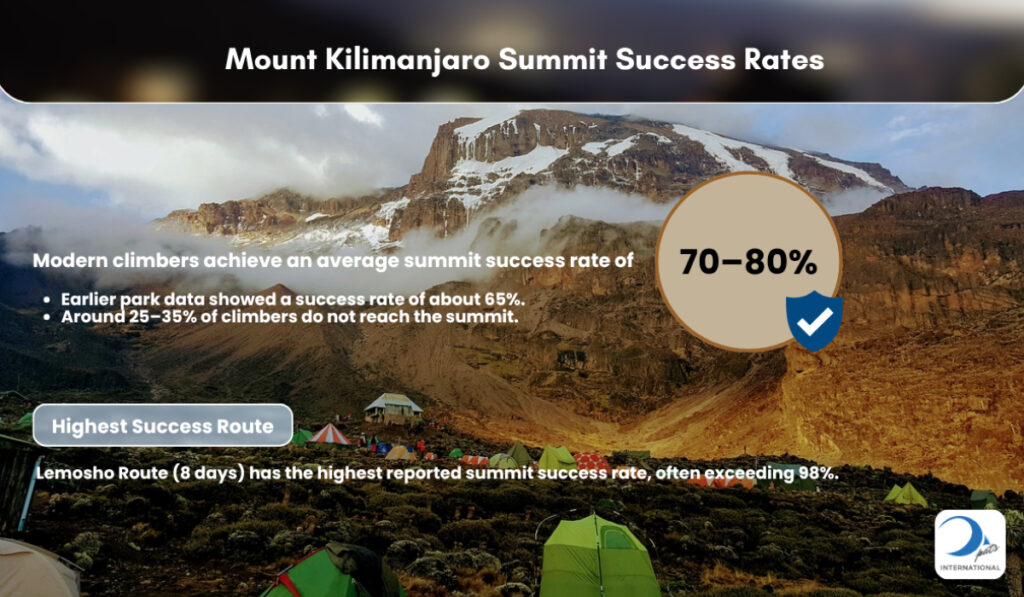
Routes lasting five days have a 42% success rate. Five-day itineraries cover Marangu and Umbwe routes. Six-day itineraries have a 60-88% success rate and cover Marangu, Rongai routes, and Machame. Seven-day trails have an 80-96% success rate and cover Lemosho, Machame, and Rongai trails. Eight-day itineraries have an 98% success rate and cover Lemosho and Northern Circuit paths. The Northern Circuit trail is a nine-day trek and has over 90% summit success rate. Rongai and Shira paths have a 80-96% success rate depending on the adjustment period. A 7-day Rongai choice has approximately 80% success rate, and a 6-day Rongai route has around 70% success rate.
What is the failure rate of Mount Kilimanjaro?
The failure rate of Mount Kilimanjaro depends on path selection and duration. The overall failure rate is approximately 21%. Old Kilimanjaro National Park statistics show a 35% failure rate. However, modern operators with well-led trips allow better outcomes. Length of the route determines how many people fail. Routes of five days have a 58% failure rate, and Marangu’s five-day routes have a 44-56% failure rate. Routes of one week lower failure. Routes of 9 days reduce failure to 8%. The Northern Circuit, the longest route at 9 days, has the third highest success rate at over 90%.
Tours using the Machame route make up roughly 50% of all climbers. Some operators report an 85% success rate for the one-week Machame route, so the failure rate is 15%. Some operators cite a 90% success rate for the 7-day Machame Trail, so the failure rate is 10%. Carefully planned climbs have a 15% failure rate. Success rate figures from individual operators range from 65% to 98.9%, which is why failure rates range from 35% to 1.1%.
Mount Kilimanjaro is a nontechnical trek. However, high altitude impacts most climbers. High-altitude illness and insufficient acclimatization leads to failure. Getting used to the altitude is the key factor in reaching the summit. Climbers boost chances by ascending gradually, staying hydrated, and choosing longer itineraries. Because of inadequate acclimatization, the Marangu trail has poor success rates and high failure rates. Choosing shorter itineraries leads to failure.
How many people summit Mount Kilimanjaro each year?
50,000 people try to summit Mount Kilimanjaro per year. The chance of succeeding is nearly two-thirds; 32,500 mountaineers arrive at the top per year. The main factor affecting summiting is acclimatization.
Which Kilimanjaro route has the highest success rate?
The Kilimanjaro route with the highest success rate is given in the table below.
| Route | Success | Days |
| Lemosho | 98% | 8 |
| Lemosho | 96% | 7 |
| Northern Circuit | 92% | 9 |
| Machame | 92% | 7 |
| Machame | 88% | 6 |
| Rongai | 80% | 7 |
| Umbwe | 60% | 6 |
| Marangu | 56% | 6 |
| Marangu | 42% | 5 |
The success rate of Kilimanjaro routes depends on days spent on the mountain. Longer itineraries boost outcomes because a gradual profile is vital and the ‘climb high, sleep low’ strategy is necessary. Physical preparation affects how many people finish, but route selection matters more than fitness. Proper pacing and how well the staff works affect finish rates.
The Northern Circuit Route has the third highest success rate at 92%. The Northern Circuit Route has the best acclimatization thanks to its long gradual profile. It goes around the northern slopes and takes just over a week. More days equals higher summit success, and the north path at nine days has the longest ascent.
The Lemosho Route with a one week itinerary has a success rate of 96%. Lemosho is the best route for new hikers and has excellent acclimatization. It uses a Kosovo overnight stop as a high camp and has more scenic variety. The Machame Route with a one week itinerary has a success rate of 88-92%. Machame is the topmost favorite Kilimanjaro route, has good scenery, and has a good climbing plan for adjusting to altitude. Machame covers a 62km (38.5 miles) distance. The Rongai Route with a one week itinerary has an 80% success rate. Rongai comes from the north and is suitable for a less rainy and crowded trek because it has less traffic. However, Rongai does not have a ‘climb high, sleep low’ profile. Marangu Route needs careful consideration because its hut-based accommodation encourages shorter trips and the rapid ascent leads to lower success. Marangu with eight days has a success rate of 44%, so it needs longer schedules to reach 85%.
I climbed Kilimanjaro and chose the north side route. The journey lasted nine days and went around the northern slopes, so my body adjusted to altitude. The route showed high mountain wilderness, remote landscapes, and northern glaciers.
Is the Machame route on Mount Kilimanjaro difficult?
Yes, the Machame route on Mount Kilimanjaro is difficult. The route is known as the Whiskey Route. The Machame route assessment puts the route as a demanding option, with a moderate to difficult level. Difficulty comes from steepness, high altitude conditions, and distance.
The itinerary is typically about a week, and a 7-day option gives better acclimatization. The trek length is 62 kilometers (38.5 miles), with a total climb in height of 4.9 kilometers (3 miles). Summit night takes 11 to 15 hours. The trek is completed by 35 percent of Kilimanjaro climbers.
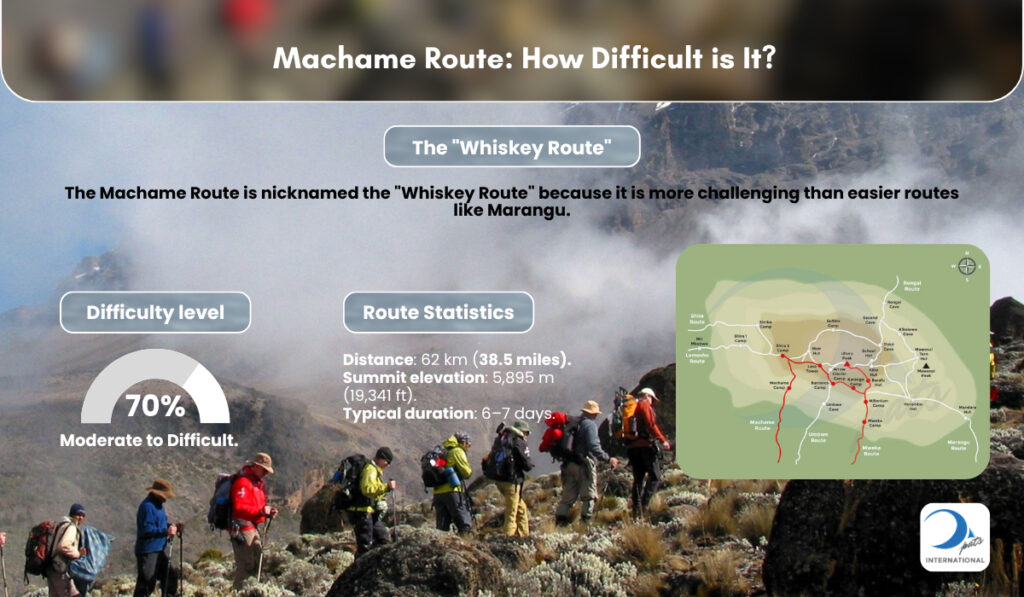
The Machame route profile has changes in height and a ‘climb high, sleep low’ acclimatization pattern. The Machame route climbs from Machame Gate at about 1 mile high (1.6 kilometers) to the summit at 5,896 meters (19,344 feet). Altitude reaches almost 5,900 meters (19,357 feet) at the summit. The route profile has steep ascents and descents and does not have a gradual approach. Steepness is notable on day one and during the Barranco cliff scramble. Terrain changes from lush rainforest to moorland, alpine desert, freezing peaks, muddy rainforest to loose scree and rocky sections.
The Machame route has camping throughout. Machame route camps cover Machame, Shira, Barranco, Karanga, Barafu, and Millennium or Mweka. The route has diverse scenery, including Shira highlands, a steep rock face, and a volcanic rock pillar. It is among the best for scenery and acclimatization, but not for seekers of solitude. Compared to the Lemosho route, the Machame route is steeper, has more people, and has similar scenery.
Climbing Kilimanjaro via the Machame route needs good fitness but no technical skills or technical equipment. Proper gear for very hot or very cold weather is needed. The Machame route demands stamina for eleven 60-minute hiking days, and intensity goes up with altitude. The route has cardiovascular demand and high altitude sickness because of thin air and cold temperatures. Physical conditioning, adequate equipment, and proper acclimatization are pivotal. A licensed Machame route guide is mandatory.

Got questions about this post?
Get free tips from John to help jumpstart your Kilimanjaro journey! Whether securing a travel visa or finding your ideal tourist destination to navigating through a list full of travel insurance policies, John will help you figure out the local tourism industry.
Chat with John