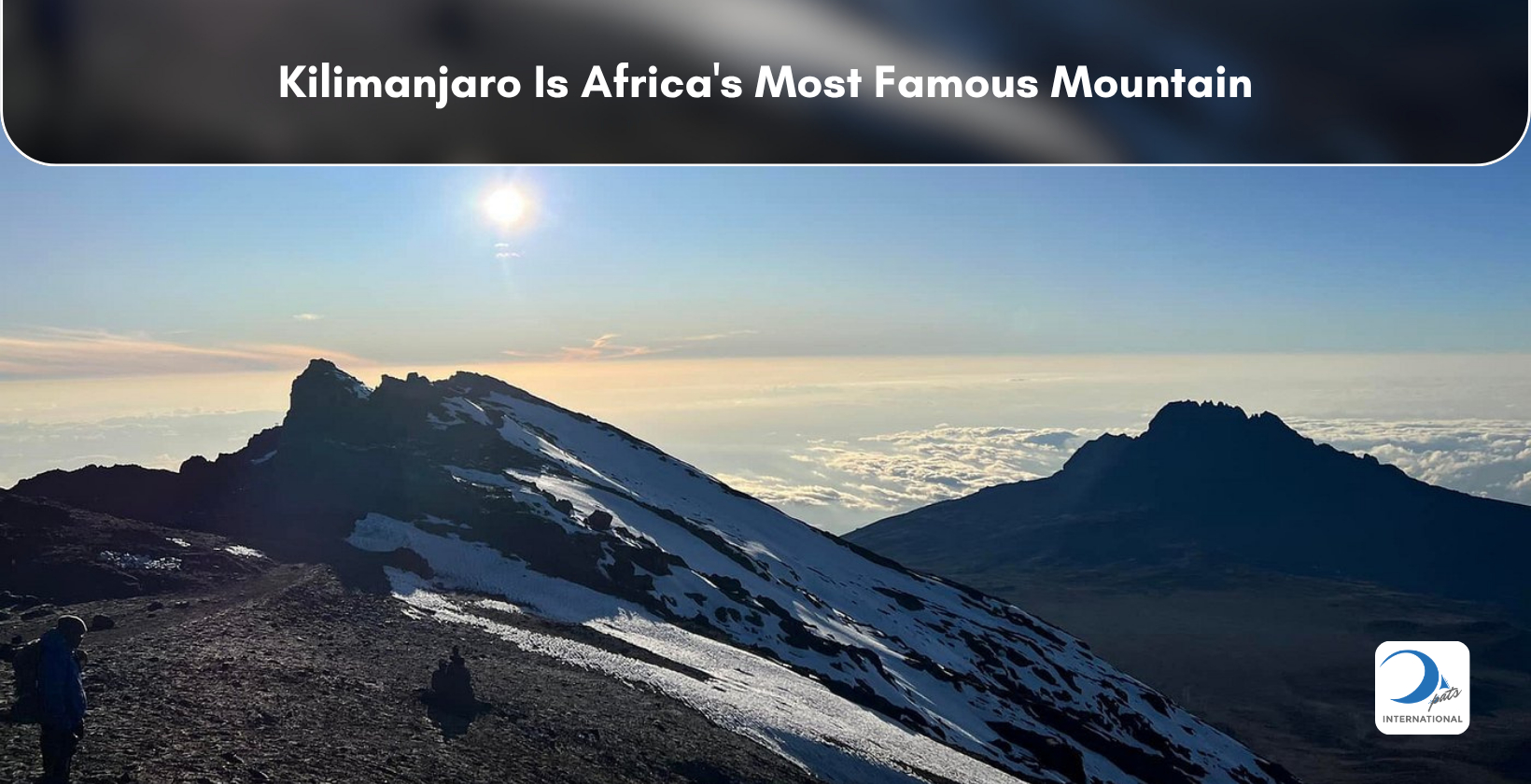
Mount Kilimanjaro is Africa’s tallest mountain and world’s tallest free-standing mountain. It is part of the world’s Seven Summits. It is located in Tanzania in East Africa. It was declared a UNESCO protected site in 1987.
What Are Your Chances of Reaching the Summit of Kilimanjaro?

We've calculated your personalized summit success score, recommended route, and training plan. Enter your details below and we'll send it straight to your inbox.
Enter your details and we'll email your personalized summit success score, recommended route, and training plan.
🔒 No spam. Your details are kept private and never shared.
Check your inbox!
Find your personalized assessment plan.
Why is Mount Kilimanjaro a top tourist attraction?
Mount Kilimanjaro is a top tourist attraction because it is a standalone volcanic peak, and the tallest in Africa. Mount Kilimanjaro rises from the plains and is nearly six kilometers high. It is visible from great distances and draws a huge number of visitors yearly. The mountain features natural reserves and ecological diversity. It has glaciers, high mountain barren land, and forests. The change in elevation allows traversal of different weather regions which adds to the attraction. Mount Kilimanjaro has routes to the summit like Marangu, Lemosho, Rongai, and Machame. Trekkers do not need technical climbing knowledge. This ease attracts beginner climbers. Mount Kilimanjaro has over 50,000 hikers yearly.
Where is Mount Kilimanjaro located in Africa?
Mount Kilimanjaro is located in Tanzania in east Africa in the Kilimanjaro protected reserve. Kilimanjaro protected reserve is a national park and global attraction. Mount Kilimanjaro is located 160 km (99.42 miles) east from the Great Rift Valley. It is 140 km (87 mi) south from Nairobi and 500 km (311 mi) northeast from Dodoma. Mount Kilimanjaro rises from the Tanzanian plains near the border with Kenya. It stands alone and does not have nearby mountains. Its position is about three degrees south of the equator situated in the tropical region. The summit is icy and has glaciers.

What is Mount Kilimanjaro National Park?
Mount Kilimanjaro National Park is a nature reserve around Mount Kilimanjaro in Tanzania, in Eastern Africa. The park became a national park in 1977, and it was declared a UNESCO protected site in 1987. This official designation as a UNESCO World Heritage Site protects the site from unsustainable development. It preserves mountain forests and biodiversity. The park attracts international visitors who are interested in mountain climbing, and it is one of the most popular adventure travel spots in Africa. It offers employment for local guides, staff, and porters.
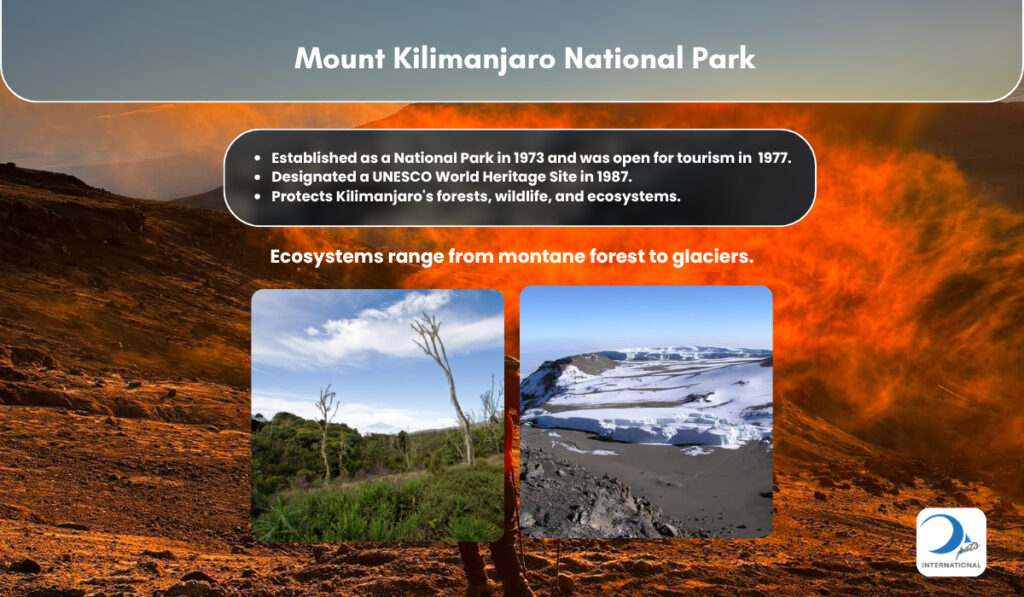
The park covers terrain from about 1,798 meters (5,900 feet) above sea level to the summit. The summit of Mount Kilimanjaro is the highest point on the African continent, with a height of nearly 5.9 kilometers (3.7 miles). The mountain has three volcanic cones: Kibo is the central highest cone, Mawenzi has a height of about 3.11 miles (5 kilometers), and Shira is the oldest cone, with a height of about 2.46 miles (3.96 kilometers). The size of the conservation zone is stable, and Tanzanian national law defines the boundaries of the park. Plant zones change with altitude; the zones are mountain woodland, heath and moorland, exposed rocky mountain top, and glaciers at the peak. Glaciers have been retreating, which is a concern for global protection work and research on mountain environments.
What is the significance of Mount Kilimanjaro?
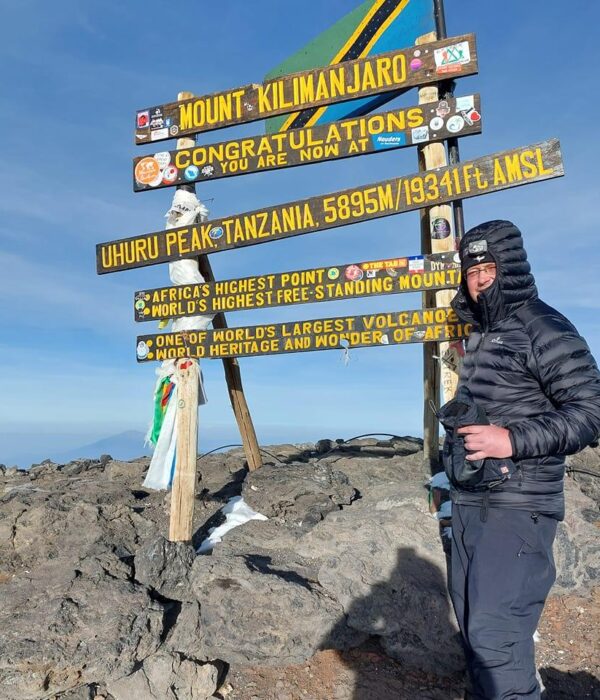
Mount Kilimanjaro’s significance goes beyond its elevation of 5,895 meters (19,341 feet). The mountain is a sacred site for the Chagga people, who believe it is the home of god Ruwa. It has a significance in Chagga stories and ceremonies, and its name has origins in the Chagga and Swahili languages. Mount Kilimanjaro means aspiration, endurance, and freedom. It stands for African independence and pride, and is a symbol of Pan-African unity and postcolonial African achievement. Due to this cultural importance, the mountain appears on Tanzanian currency and national emblems. It appears in literature, like “The Snows of Kilimanjaro”, and in advertising and political rhetoric. Traditional medicine uses plants found on the mountain, and there are ancestral graves and annual ceremonies with traditional ways of leading.
Mount Kilimanjaro received World Heritage Site recognition in 1987 for unique ecosystems and cultural criteria. The mountain has five weather regions and altitudinal plant layering by height, from misty woodland ecosystems to high-altitude barren land and a freezing peak. It hosts giant groundsels and lobelias, over two thousand five hundred types of plants, and endemism. Over 180 avian species and over 140 mammal species live there. The mountain is a major water source, with streams and watershed protection, and carbon storage in tree regions. Glaciers have diminished by 85% since 1912 and will disappear by 2060, which is why Mount Kilimanjaro is a benchmark for global warming studies and important for tropical glacier dynamics.
Due to its accessible non-technical climb, Mount Kilimanjaro is the top attraction for tourists in Tanzania and makes $50 million annually from visitors. 40-50 thousand climbers try the summit annually from 150 countries. The climb takes a week. However, mountain sickness affects up to 75% of climbers, with a chance of success around 65-70%. This economic impact supports agriculture, guiding, growing coffee, and portering, but demands management of the effects of tourists and waste.
Mount Kilimanjaro is important for scientific researchers. It has been the focus of studies dealing with the body’s response to thin air and getting used to high places, as well as glacial dynamics and atmospheric weather stations. The mountain has archaeological evidence of human presence and frozen history samples. Its prominence of about 16,000 feet (4,877 meters) and vertical relief make it a foundational landmark for the global climbing community. Mount Kilimanjaro goes beyond national boundaries in significance, representing accessible extreme high-altitude climb, enduring cultural heritage, and ecological diversity.
What is the history of Mount Kilimanjaro?
Mount Kilimanjaro is a stratovolcano located in East Africa. It has three volcanic cones: Shira, Kibo, and Mawenzi. Shira formed 2.5 million years ago and is a volcanic tableland; its eruptions stopped millions of years ago. Kibo is the youngest cone and reaches 5,895 meters (19,340.55 feet). Kibo is dormant and has fumarolic activity. The last major eruption of Kibo happened 150,000 and 360,000 years ago, but minor activity happened 200 years ago.
Mount Kilimanjaro has been a landmark for human populations for millennia. The Chagga people settled around the mountain 400 years ago, and introduced Mount Kilimanjaro to European audiences in 1848. A German geologist, Dr. Hans Meyer, made the first ascent to the top of Kibo on October 6, 1889, and went with a local guide. Sheila MacDonald climbed in 1927 as the first woman to the summit. After World War I, the area was a British mandate due to the League of Nations. Mount Kilimanjaro’s archaeology is limited; few traces of early settlements remain, and stone dishes and artifacts show early human presence. The mountain was a landmark for Arab and Chinese traders for centuries.
The Kilimanjaro protected area covers 1,668 square kilometers (644.0 square miles) above 800 metres (2625 feet), and UNESCO named it a protected site in 1987. The site grew in 2005 and covers the entire tropical forest. Glaciers have lost more than eight out of every hundred parts of mass since 1912. The Reusch Ash Hole commemorates Richard Reusch, a founder of the Mountaineering Club of East Africa, who built early tourist facilities in the 1920s.

Got questions about this post?
Get free tips from John to help jumpstart your Kilimanjaro journey! Whether securing a travel visa or finding your ideal tourist destination to navigating through a list full of travel insurance policies, John will help you figure out the local tourism industry.
Chat with John