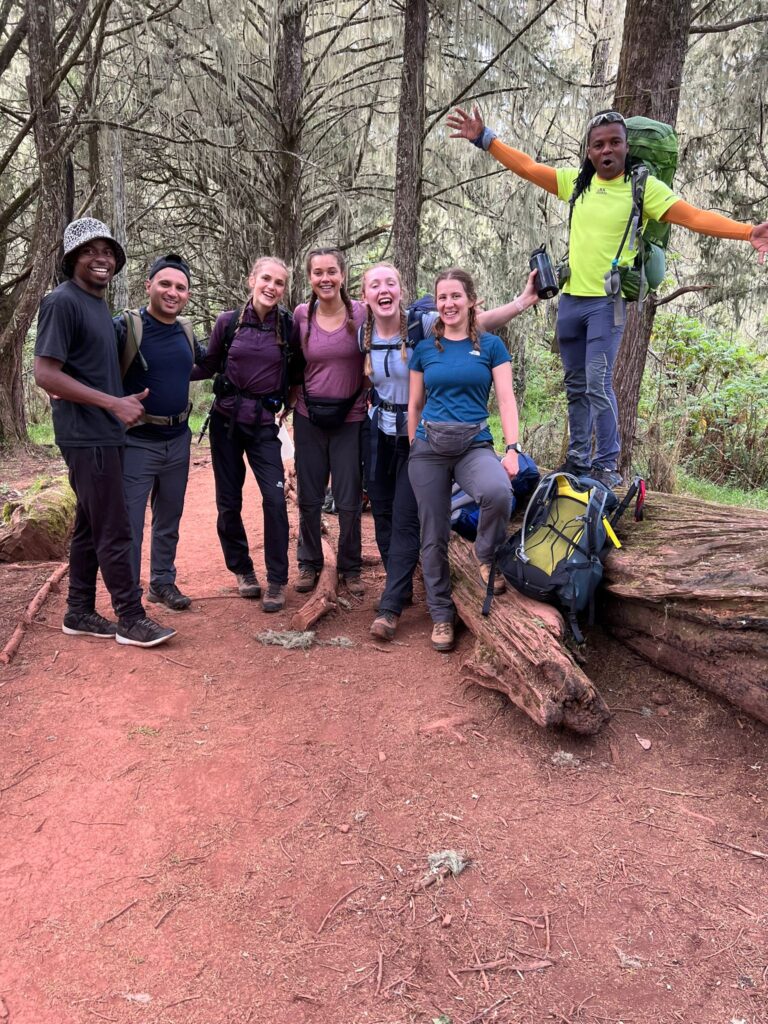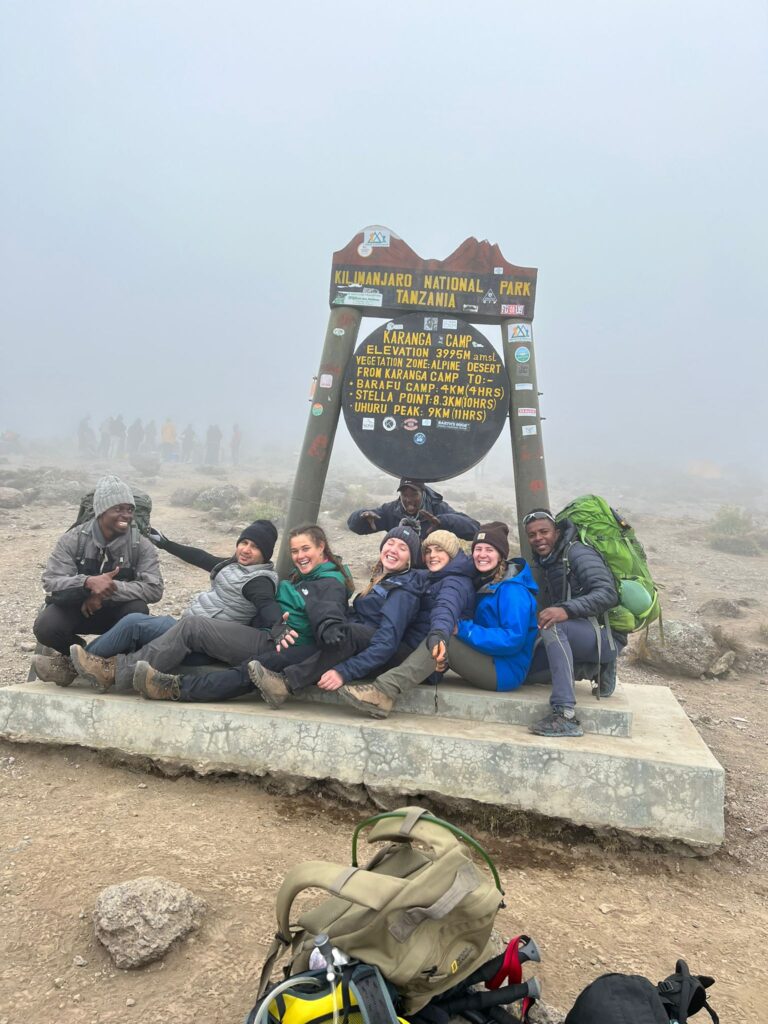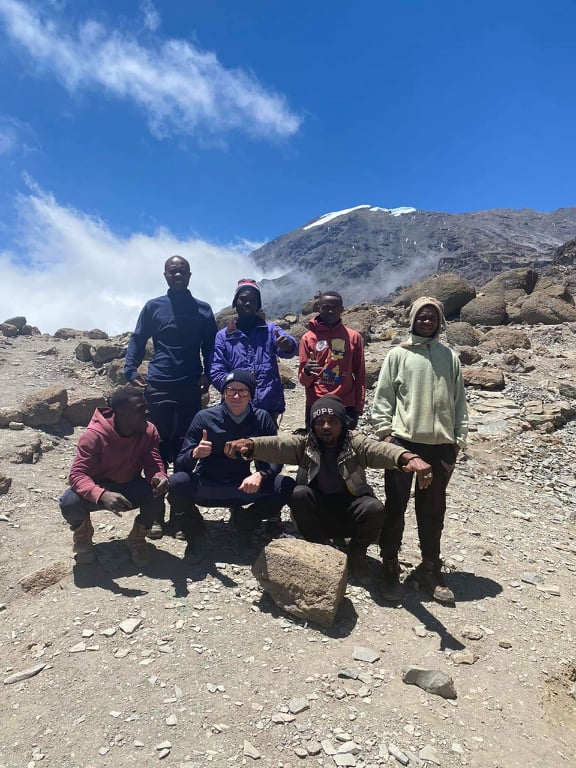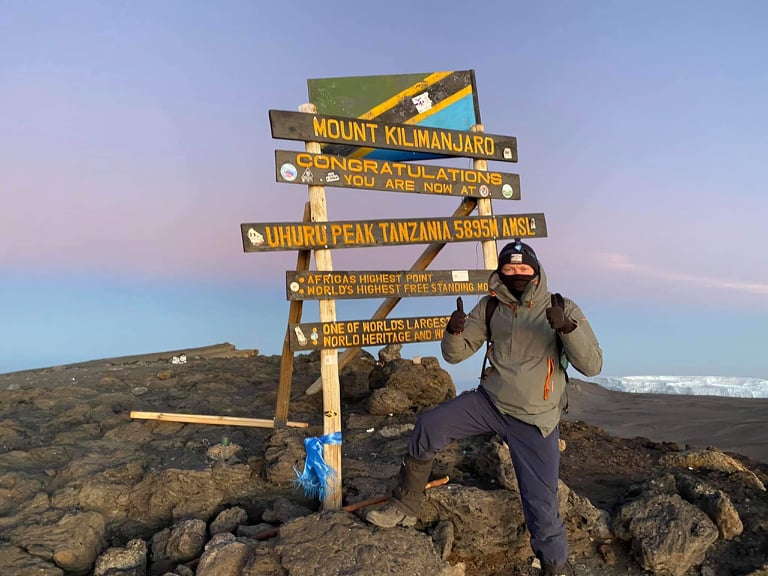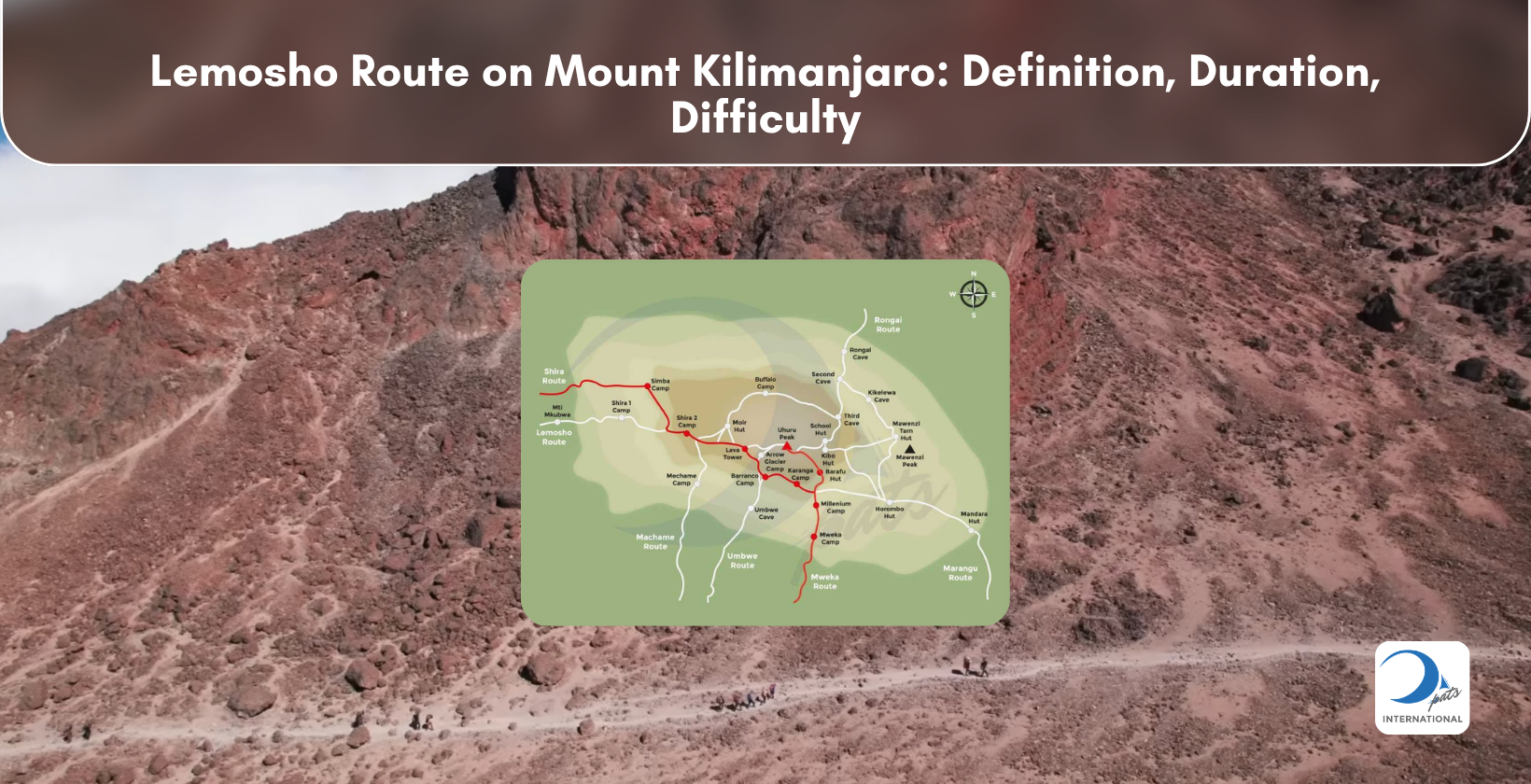
The Lemosho route is located on western side of Mount Kilimanjaro. The Lemosho route is widely regarded as the most scenic and well-balanced trail to climb Mount Kilimanjaro. It is deemed a moderately difficult route due to distance and elevation gain. The 6-day Lemosho route covers around 56 km. The 8-day Lemosho route spans 43 miles, approximately 70 km, and this itinerary is built around the fundamental principle of acclimatization. Because of this, it gives the best chance of making the summit of Kilimanjaro and is deemed one of the easiest routes on Kilimanjaro.
What Are Your Chances of Reaching the Summit of Kilimanjaro?

We've calculated your personalized summit success score, recommended route, and training plan. Enter your details below and we'll send it straight to your inbox.
Enter your details and we'll email your personalized summit success score, recommended route, and training plan.
🔒 No spam. Your details are kept private and never shared.
Check your inbox!
Find your personalized assessment plan.
- What is the Lemosho Route on Mount Kilimanjaro?
- Where is the starting point of the Lemosho Route on Mount Kilimanjaro?
- How long does the Lemosho Route on Mount Kilimanjaro take?
- What is the length of the Lemosho Route on Mount Kilimanjaro?
- Is the Lemosho Route on Mount Kilimanjaro difficult?
- What is the day-by-day itinerary of the Lemosho Route on Mount Kilimanjaro?
- Is the Lemosho Route the most beautiful route on Mount Kilimanjaro?
- What is the success rate of the Lemosho Route on Mount Kilimanjaro?
- How much does the Lemosho Route on Mount Kilimanjaro cost?
What is the Lemosho Route on Mount Kilimanjaro?
The Lemosho Route, widely deemed to be the best and most scenic route, is the route with the highest success rate and is the best all-around route for most hikers. It approaches the mountain from the west, starting at Londorossi Gate on the western flanks. The route covers 70 kilometres (43.5 miles) in total, with a total ascent of 4,967 metres (16,296 feet) and descent of 5,585 metres (18,323 feet), finishing at Mweka Gate.
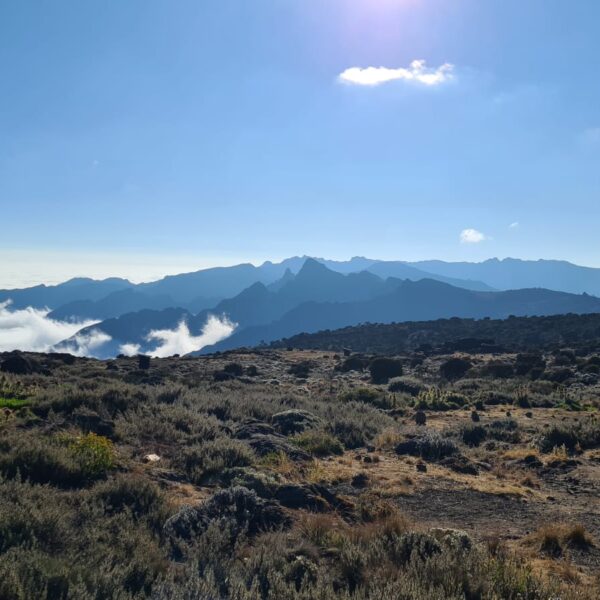
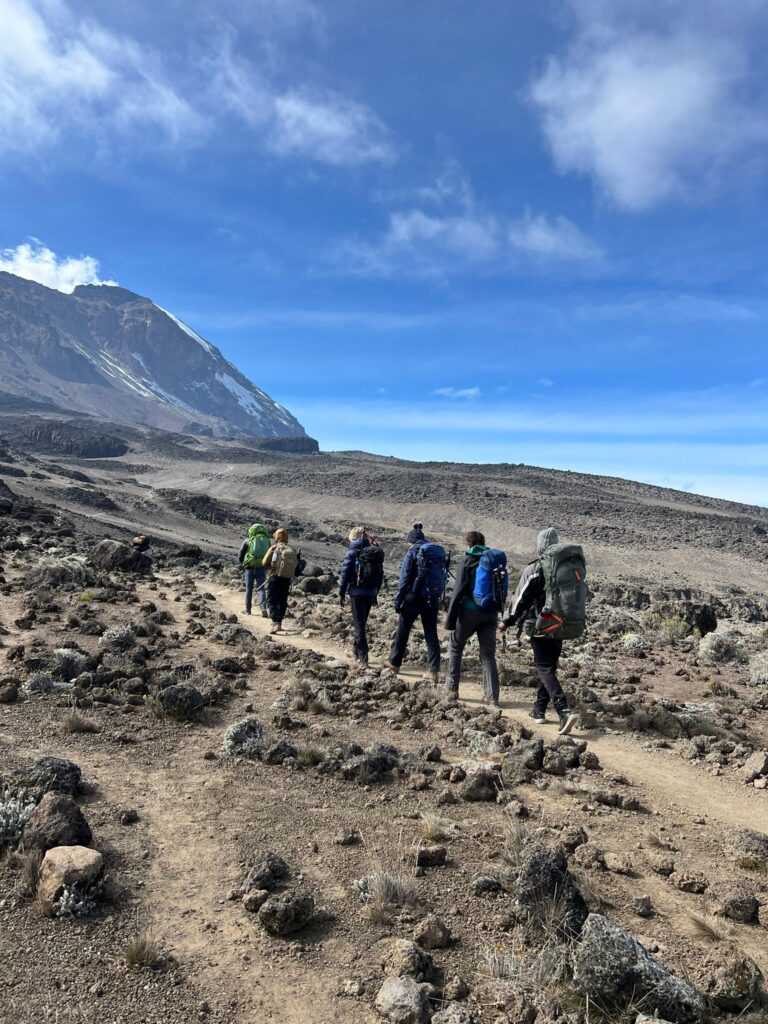
The first couple of days are spent trekking through a rainforest to Shira Ridge. In the forest, hikers spot wildlife, including monkeys and antelopes. After the rainforest, the trail crosses the entire Shira Plateau from west to east, a relatively flat hike with panoramic vistas. On day 4, the Lemosho Route joins the Machame route near Lava Tower, a volcanic outcrop, and then the path winds below Kibo Peak’s Southern Ice Field. The route includes a steep rock face called Barranco Wall, which is non-technical and gives climbers amazing views.
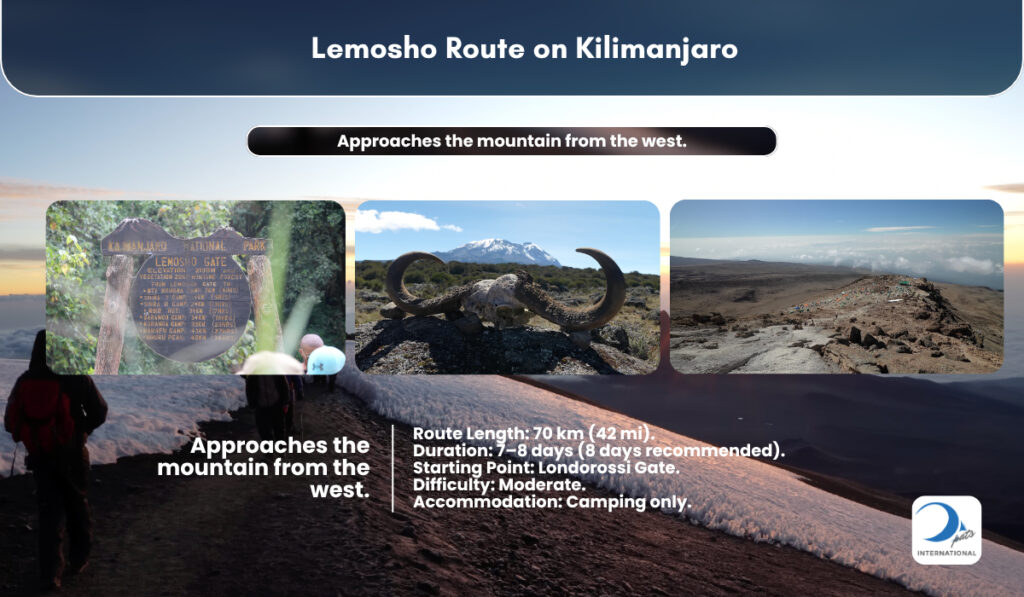
The Lemosho Route offers a great acclimatization profile and maximizes the chance that a climber will reach the summit. The average summit success rate is 97%. For the first three days, the route enjoys relatively quiet trails before joining the Machame route, after which crowds increase, especially during busy times. One feature of the route is Dendrosenecio kilimanjari, huge alien-looking plants that are only found on this mountain.
The entire route requires camping accommodation. It is available in 6, 7 and 8-day itineraries, with the 8-day plan having the highest summit success rates. The cost of climbing the Lemosho Route typically falls between $3,500 and $4,000, with a common price of $3,890 including park entry charges, meals, equipment, guides, and accommodation. The route has a moderate difficulty rating, requiring fitness but is accessible to trekkers without special skills.
Where is the starting point of the Lemosho Route on Mount Kilimanjaro?
The starting point of the Lemosho Route on Mount Kilimanjaro is Lemosho Gate. The Lemosho Gate has a location west of Mount Kilimanjaro, which is why the route departs from the far West side. The beginning has a height of 2,100 meters (about 6,900 feet) and that gives adaptive acclimatization. Access to the trail begins with a long drive from Moshi or Arusha to Londorossi Gate. The distance from Moshi to Lemosho Gate is between 55.9 and 68.4 miles (90 and 110 kilometers), and the drive takes three to four hours. Climbers sign in at the entry point at Londorossi Gate, and then use Lemosho Gate via the big door at Londorossi. The hike starts in lush fertile rainforest.
The Lemosho route is a camping route, so its camps include the Big Tree Camp at 2,650 meters (8,694 feet), Shira One Camp at 3,510 meters (11,516 feet), Moir Hut at 4,200 meters (13,780 feet), Barranco Camp at 3,900 meters (12,795 feet), Karanga Camp at 3,960 meters (12,992 feet), Barafu Camp at 4,680 meters (15,354 feet), and Mweka Camp at 3,100 meters (10,171 feet). Due to the west-side start, trekkers enjoy views of the Shira Plateau and Kibo Peak as the route crosses the Shira Plateau, one of the largest high-altitude plateaus in the world. Because the Lemosho Route is often called Kilimanjaro’s most beautiful trail, it has gained much popularity. The Lemosho Route joins the Machame route near Lava Tower, so the trail goes through high mountain forest and gets to the alpine zones quickly after the forest.

How long does the Lemosho Route on Mount Kilimanjaro take?
The Lemosho Route on Mount Kilimanjaro takes anywhere from 6 to 9 days. The 8-day Lemosho route is the most optimum choice. The 7-day Lemosho variation combines days five and six and does not stop at Karanga. Because of this, the 7-day creates discomfort from fast climbing. The 8-day route has a better altitude acclimatization schedule. Eight days on Lemosho Route has a summit success rate around 90%.
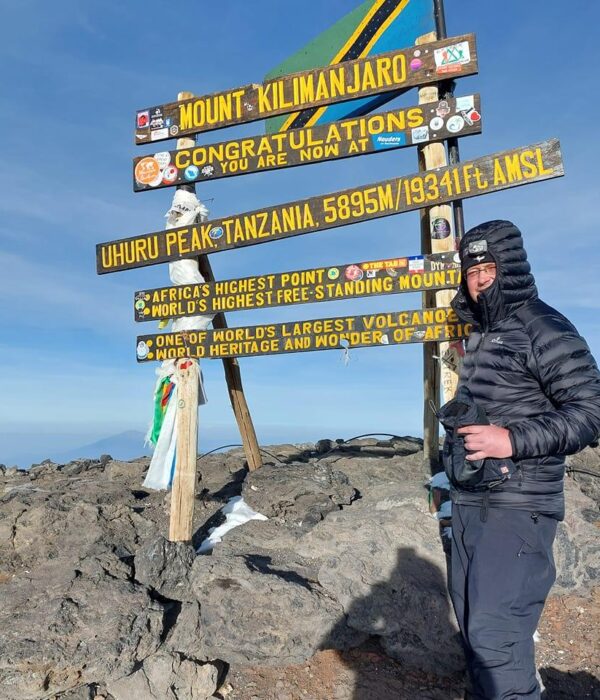
The Lemosho route’s total distance is 43 miles or 70 kilometres. The 8-day itinerary covers about 43 miles (69 kilometers). The elevation gain is approximately 16,000 to 17,000 feet (4,877 to 5,182 meters). The summit, Uhuru peak, reaches a height of 19,341 feet (5,895 metres). On the summit day, you depart from Barafu Camp around midnight. The ascent to the top is about 5 kilometres. Then you descend about 11 kilometres to the bottom camp. The trip includes dining tents, talented staff, commode toilet tents, and chefs.
What is the length of the Lemosho Route on Mount Kilimanjaro?
The Lemosho Route’s length is approximately 70 km (43.5 miles) from gate to gate. The exact trekking distance for the Lemosho Route is 71 km (44.1 miles). If you follow a 6 or 7-day variation, the distance covered is around 56 km (35 miles). The standard eight-day itinerary covers roughly 70 km (43 miles).
Is the Lemosho Route on Mount Kilimanjaro difficult?
The difficulty of the Lemosho route changes depending on the length of the itinerary. The route requires ascent of the Barranco Wall, a challenging section with loose rocks. However, Lemosho Route’s classification is non-technical, and it requires no technical climbing, no gear for climbing, and no expertise. The strains are cardiovascular, so hikers need strong legs, resilience, and the ability to hike 5 to 8 hours daily. The Lemosho route requires a good level of fitness, and vigorous training is vital.
The Lemosho route’s longer itinerary, over 8 days, allows for better acclimatization. The ‘climb high, sleep low’ acclimatization schedules at Lava Tower give the body time to acclimatise. The ascent is gradual, and hikers rarely get altitude sickness on the Lemosho Route. Because of this, the Lemosho Route summit success rate is around 98% on the 8-day itinerary. The route cuts the risk of air sickness and is safer than difficult routes. So while summit night is hard, the Lemosho Route is moderate, and with preparation, it is manageable.
What is the day-by-day itinerary of the Lemosho Route on Mount Kilimanjaro?
The Lemosho Route is available in six to eight-day itineraries. The eight-day itinerary is the standard for climbing Mount Kilimanjaro. The route begins from west, on the western slope of Kilimanjaro. Day 1 goes from Londorossi Gate to Forest Camp. Londorossi Gate has elevation 7,800ft (2,377m), and Forest Camp has elevation 9,500ft (2,896m). The distance is 6 km (3.73 miles), and hiking time is 3 hours (180 minutes). The habitat is rainforest, and trekking occurs in fertile rainforest. Day 2 goes from Forest Camp to Shira 1 Camp. Elevation goes from 9,500ft (2895.6m) to 11,500ft (3505.2m). The distance is 8 km (4.97 miles), and hiking time is 56 hours (2.33 days). The habitat is moorland, and the route breaks out on to the zone of heather.
Day 3 goes from Shira 1 Camp to Shira 2 to Moir Hut. Elevation goes from 11,500ft (3,505.2m) to 13,800ft (4,206.2m). Distance is 14 km (8.7 miles), and hiking time is 57 hours (2.4 days). The habitat is moorland, and you cross Shira Plateau, one of the most beautiful areas on Kilimanjaro. Day 4 goes from Moir Hut Camp to Lava Tower to Barranco Hut Camp. Elevation is from 13,800ft (4,206.24m) to 13,000ft (3,962.4m). Distance is 7 km (4.35 miles), and hiking time is 46 hours (1.92 days). The habitat is semi-desert, and you join the Machame route near Lava Tower.
Day 5 goes from Barranco Camp to Karanga Camp. Barranco Camp has an elevation of 13,000ft (3,962m), and Karanga Camp has an elevation of 13,100ft (3,993m). Distance is 5 km (3.11 miles), and hiking time is 45 hours (1.88 days). The habitat is alpine desert. Day 6 goes from Karanga Camp to Barafu Camp. The habitat is Alpine Desert, and hiking time is 45 hours.
Day 7 goes from Barafu Camp to Uhuru Peak to Mweka Camp. Barafu Camp to Summit to Mweka Hut has elevation 15,300ft (4,663m) to 19,345ft (5896m) to 10,000ft (3,048m). The ascent is 5 km (3.11 miles), and descent is 12 km (7.46 miles). The ascent’s hiking time is 78 hours, and descent’s is 46 hours. The habitat is arctic at the summit, altering to rainforest. Day 8 goes from Mweka Camp to Mweka Gate to Moshi. Mweka Camp has an elevation of 10,000ft (3,048m), and Moshi is 5,400ft (1,646m). Distance is 10 km (6.21 miles), and hiking time is 34 hours (1.42 days). The habitat is rainforest, and the descent follows Mweka Route back down through rainforest.
Is the Lemosho Route the most beautiful route on Mount Kilimanjaro?
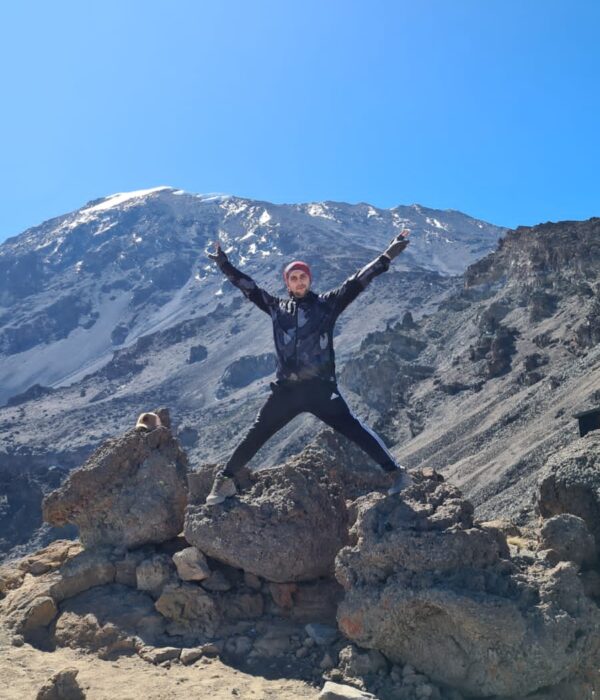
Yes, the Lemosho Route is the most beautiful route of all trekking trails up Mount Kilimanjaro. It offers a perfect blend of stunning views, rich wildlife, and diverse ecosystems. The scenery covers ice, lush rainforest, and a high cold barren area. The rainforest has black and white monkeys and vervet monkeys. Beautiful forests traverse the base of Mount Kilimanjaro. The route crosses the Shira Plateau, with sweeping views of Mount Meru. The alpine desert has sweeping views of Kilimanjaro’s jagged ridges. The trail offers panoramic views from Barranco Wall. The Lemosho Route shows the top of the volcano, near the flat part of the hill. Dendrosenecio plants and lobelias in the big rocky canyon add to the beauty. The trekker explores less busy paths before the route joins the Machame route. The 8-day itinerary is the most beautiful choice on the mountain.
What is the success rate of the Lemosho Route on Mount Kilimanjaro?
The success rate of the Lemosho Route on Mount Kilimanjaro varies with the length of the itinerary: the 8-day route has a success rate of over 98%, the 7-day route has a success rate of 96%, and the 6-day route has a success rate of over 88%. The Lemosho Route is widely regarded as one of the most successful trails on Kilimanjaro. Summit success rates on Lemosho are one of the highest on the mountain, due to a good acclimatization profile. The route allows for gradual altitude gain and a steady ascent, which makes acclimatization easy. The success rates change by operator and by how good someone is at climbing, but the route design helps acclimatization.
How much does the Lemosho Route on Mount Kilimanjaro cost?
The Lemosho route’s estimated cost is $3800 to $6500. The cost varies by duration and number of clients. For a 7-day climb, the cost is around $3506. An 8-day group climb with XPATS International Travel costs $3801 per person sharing. The 8-day itinerary group has a price of $3801 per person. The 9-day climb costs around $4277 to $7500. A 12-day trek costs $5702.
Conservation fees are $70 per day totaling $490 for 7 days. Campsite fees cost $50 per night and come to $300. There is a non-refundable registration fee of $300.00 and a deposit of $700.00. Tips for crew are $350 – $400. Gear rental is $100 – $150. Travel insurance is $75 – $100. Flights are $1600 – $8000. The minimum cost to climb Kilimanjaro is $2900.

Got questions about this post?
Get free tips from John to help jumpstart your Kilimanjaro journey! Whether securing a travel visa or finding your ideal tourist destination to navigating through a list full of travel insurance policies, John will help you figure out the local tourism industry.
Chat with John